Why In Home Drum Lessons Help Students Practice More Consistently
Learning drums takes time, patience, and regular practice. For many students, the hardest part is not the lesson itself. It is building a routine that feels manageable during the week. That is one of the biggest reasons in home drum lessons can work so well for kids, teens, and adults.
When lessons happen at home, students learn in the same space where they practice. The drum set, practice pad, seat height, pedal position, cymbal placement, and room setup are all part of the learning process. This allows the teacher to help the student build skills in a way that fits their real practice environment.
In home drum lessons make the process easier for busy families and working adults. There is no drive to a studio, no extra waiting time, and no need to rush across town after school or work. Students can stay focused on learning, and parents can see what is being taught each week.
Students Learn on Their Own Drum Setup
Every drum setup is a little different. Some students have a full acoustic drum set. Some have an electronic kit. Others begin with a practice pad, sticks, and a plan to add more equipment later.
In home drum lessons allow the teacher to work with what the student already has. If the drum throne is too low, the snare is too far away, or the pedals are uncomfortable, those things can be corrected right away. Small setup changes may make a big difference in how relaxed and confident a student feels while playing.
A good setup can help students:
Sit with better posture
Reach the drums more comfortably
Use the pedals with better control
Avoid unnecessary tension
Practice with better consistency
Feel more confident behind the kit
Drumming is physical. When the setup feels natural, students can focus more on timing, coordination, and music.
In Home Lessons Build Better Practice Habits
Many students finish a lesson excited, then forget what to practice a few days later. A clear practice plan can help fix that.
During in home drum lessons, students can be shown exactly how to practice in their own space. The teacher can help them create a simple weekly routine that fits their schedule and attention span. This is especially helpful for younger beginners who may need structure to stay focused.
A useful drum practice routine may include a short warmup, a beat, a fill, a song section, and a few minutes of playing for fun. Students do not need to practice for hours at a time to improve. Short and focused practice sessions may build stronger results than long sessions without direction.
Lessons Can Be Customized for Each Student
Every drum student learns differently. Some students love reading drum notation. Some learn faster by listening and copying. Some need to move slowly through coordination exercises, while others want to jump into songs right away.
Private in home drum lessons give the teacher room to adjust the lesson around the student. A beginner may need help with counting, grip, and basic rock beats. A teen may want to learn songs from their favorite band. An adult may want to build timing, coordination, or return to drumming after years away.
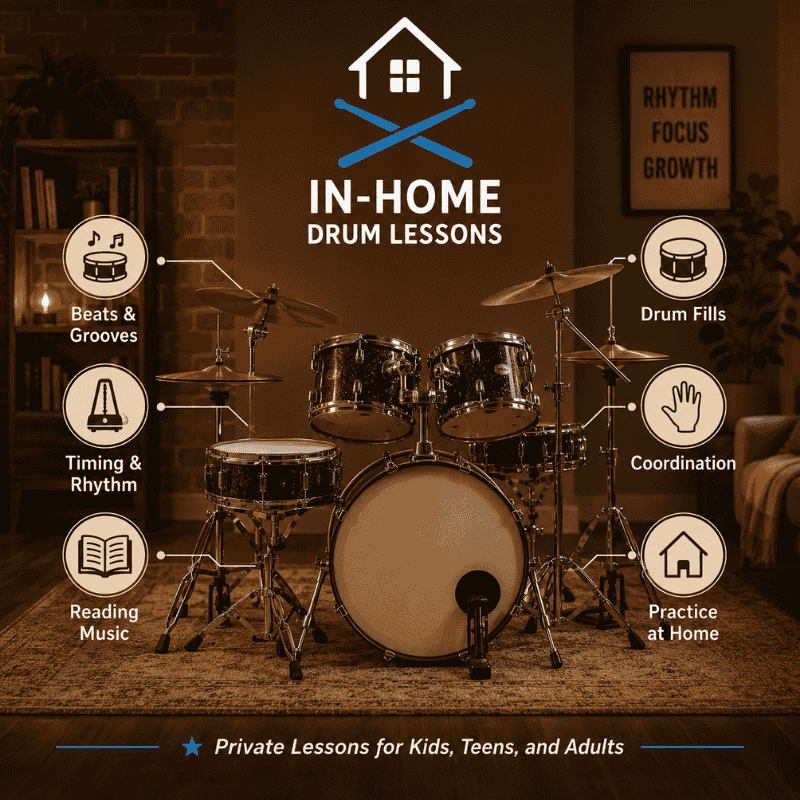
Lessons may include:
Basic drum beats
Drum fills
Rudiments
Reading drum notation
Hand and foot coordination
Bass drum technique
Hi hat control
Timing with a metronome
Learning songs
Building confidence behind the kit
The goal is to keep lessons structured while still making them feel personal and motivating.
In Home Drum Lessons Are Helpful for Beginners
Starting drums can feel overwhelming at first. Students are using both hands, both feet, and their ears at the same time. A beginner may feel uncoordinated in the beginning, but that is normal.
In home drum lessons give beginners a comfortable place to learn the basics. Students can ask questions, slow things down, repeat exercises, and build confidence without feeling rushed. The first few lessons often focus on simple skills that create a strong foundation.
Beginner students usually work on stick grip, basic counting, snare and bass drum coordination, simple rock beats, and easy fills. Once those skills become more comfortable, the student can begin learning songs and more detailed patterns.
Parents Can Better Understand the Lesson Plan
For kids and teens, in home drum lessons can also help parents stay connected to the student’s progress. Parents do not need to sit through the whole lesson, but being nearby makes it easier to understand what the teacher assigned for practice.
This can help parents support the student during the week. They can encourage short practice sessions, remind the student what to review, and notice progress over time.
Parents also get a clearer sense of how the student learns. Some students need encouragement. Some need a steady routine. Some need songs that keep them excited. In home lessons make it easier to adjust the plan when needed.
Drumming Helps With More Than Music
Drum lessons can help students build skills that go beyond the instrument. Drumming may support focus, listening, patience, coordination, memory, and confidence. It gives students a physical way to experience rhythm and structure.
For some students, drums become a creative outlet. For others, they become a way to develop discipline and confidence. A student who learns how to slow down, count carefully, and practice consistently may carry those habits into other parts of life.
In Home Drum Lessons in the South Bay Area
In Home Drum Lessons are available for students in the South Bay Area, including Torrance, Redondo Beach, Hermosa Beach, Manhattan Beach, Gardena, Hawthorne, Lawndale, El Segundo, Lomita, Carson, Palos Verdes, and nearby communities.
Lessons are available for kids, teens, and adults. Students can begin as complete beginners or continue building skills from previous experience.
The teacher comes to your home, works with your current setup, and helps create a lesson plan that fits the student’s goals.
Start Learning Drums at Home
In home drum lessons can make learning drums more comfortable, consistent, and practical. Students get personal instruction, clear practice goals, and the chance to learn on the same drum set they use during the week.
Whether the student wants to learn basic beats, improve coordination, read drum notation, build better technique, or play favorite songs, private in home lessons can help create a strong foundation.
For more information or to schedule drum lessons, visit: